
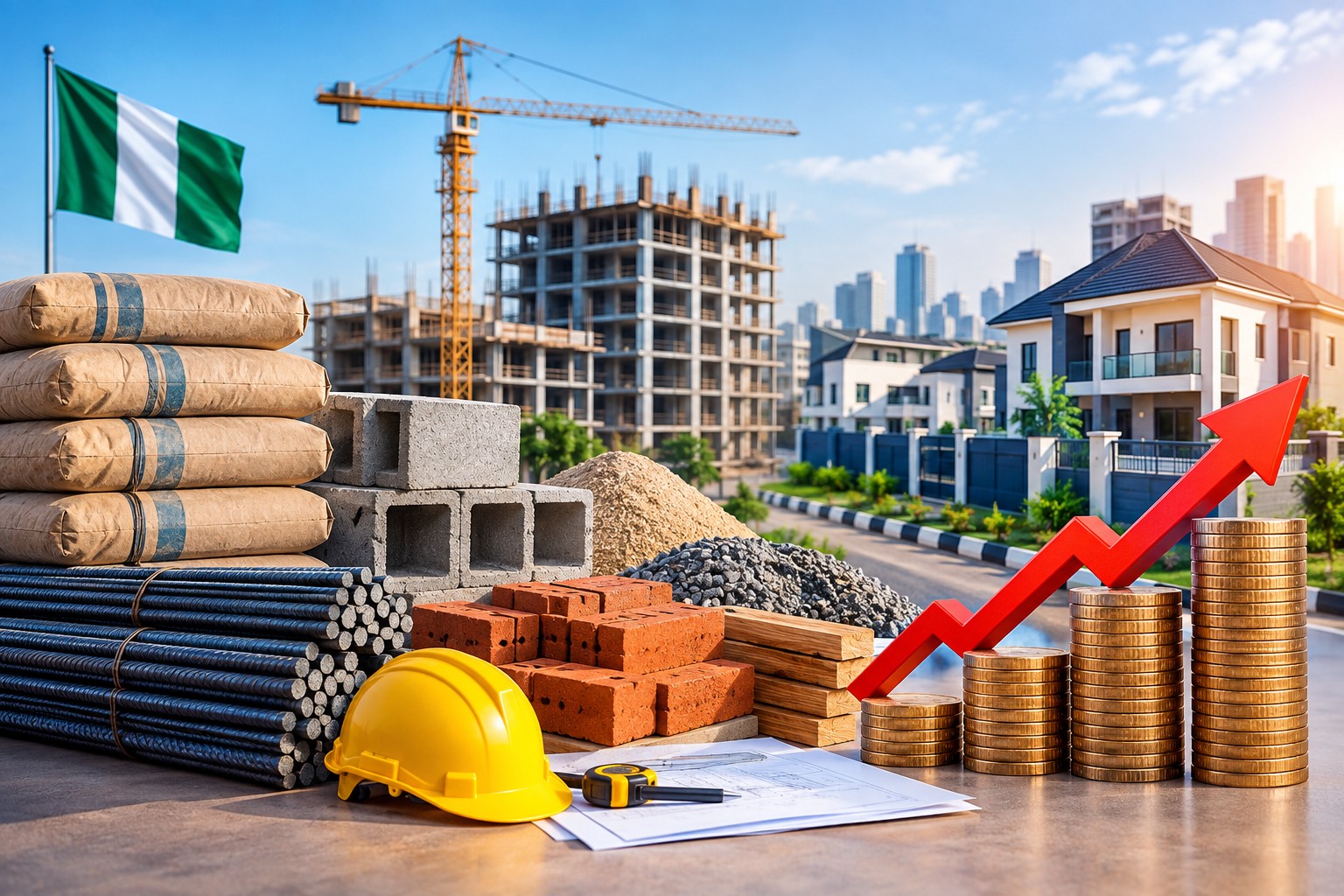
Construction Inflation in Nigeria: How Rising Building Material Costs Are Reshaping Real Estate in 2026
Building a house in Nigeria has become a significantly more expensive exercise.
For developers and homeowners, the question is no longer simply “How much land do I need?” It is increasingly “How much will it cost to actually develop that land?”
Construction inflation has become one of the biggest challenges facing Nigeria’s real estate sector.
Cement, steel, roofing materials, electrical components, labour and transportation costs continue to influence development budgets.
In August 2026, the Federal Competition and Consumer Protection Commission said its preliminary investigation had found indications of possible price manipulation in Nigeria’s cement market. The Commission noted that cement prices had risen significantly during the first half of 2026. (FCCPC)
Recent market reporting put 50kg cement prices around
₦12,500–₦15,000 in several markets, with some reports showing prices exceeding ₦15,000 in certain locations. (The Guardian Nigeria)
The impact goes far beyond cement.
Construction inflation is pushing up property prices
Developers ultimately have to recover their construction costs.
When the cost of materials rises, the cost of developing apartments, houses and commercial buildings also rises.
This creates a chain reaction:
Higher material costs → higher construction costs → higher development costs → higher property prices.
Agusto & Co.’s 2026 Lagos report says building-material prices increased by an average of
75% between 2024 and 2026, contributing to a substantial rise in housing costs. (Agusto Store)
This helps explain why buyers may see property prices rising even when consumer purchasing power is under pressure.
Cement has become a major pressure point
Cement is one of the most visible examples.
The FCCPC’s August 2026 investigation highlighted concerns about cement pricing despite Nigeria’s large limestone deposits and substantial domestic production capacity. (FCCPC)
BusinessDay reported in August that a sharp cement-price increase had forced some homeowners and developers to revise construction budgets, while PUNCH similarly reported that rising cement costs were worsening the housing affordability problem. (Businessday NG)
For a developer, a sudden increase in the price of a major construction input can disrupt the entire project budget.
Steel and imported inputs add another layer
Steel reinforcement is another important construction cost.
Even where materials are manufactured locally, production can still be affected by energy prices, exchange-rate movements, logistics and imported components.
This means
naira volatility and construction inflation remain closely connected.
When input prices change rapidly, contractors may struggle to provide fixed-price quotations over long periods.
That makes accurate budgeting increasingly important.
Developers are changing their strategies
High construction costs are encouraging developers to rethink how they build.
Some are focusing on smaller units.
Others are adopting phased developments.
Some are prioritising locations where land is more affordable.
There is also increasing interest in
renovation, adaptive reuse and retrofitting existing structures where redevelopment is financially more attractive than starting from scratch.
This does not mean new construction is disappearing.
Nigeria’s housing deficit remains enormous, so new housing supply is still essential.
Instead, the industry is being forced to become more cost-conscious.
Affordable housing is becoming more difficult—and more necessary
The greatest consequence of construction inflation may be its effect on affordability.
Nigeria needs more housing, but if the cost of producing homes keeps rising faster than household incomes, the affordability gap becomes wider.
This creates a difficult situation:
Demand is high, but purchasing power is limited.
Developers therefore have to find ways to deliver housing that balances:
Cost + quality + location + affordability.
Conclusion
Construction inflation is no longer a secondary issue in Nigerian real estate.
It is influencing property prices, development timelines, housing affordability and investment decisions.
For developers, accurate cost planning is essential.
For buyers, understanding the relationship between construction costs and property prices can provide valuable market context.
And for investors, the key question is increasingly:
“What does it actually cost to reproduce this property today?”
In a market where building materials can change rapidly, the value of real estate cannot be separated from the cost of creating and maintaining it.
Nigeria’s housing market needs more supply—but making that supply affordable will remain one of the industry’s biggest challenges in 2026.

Leave a Reply
You must be logged in to post a comment.